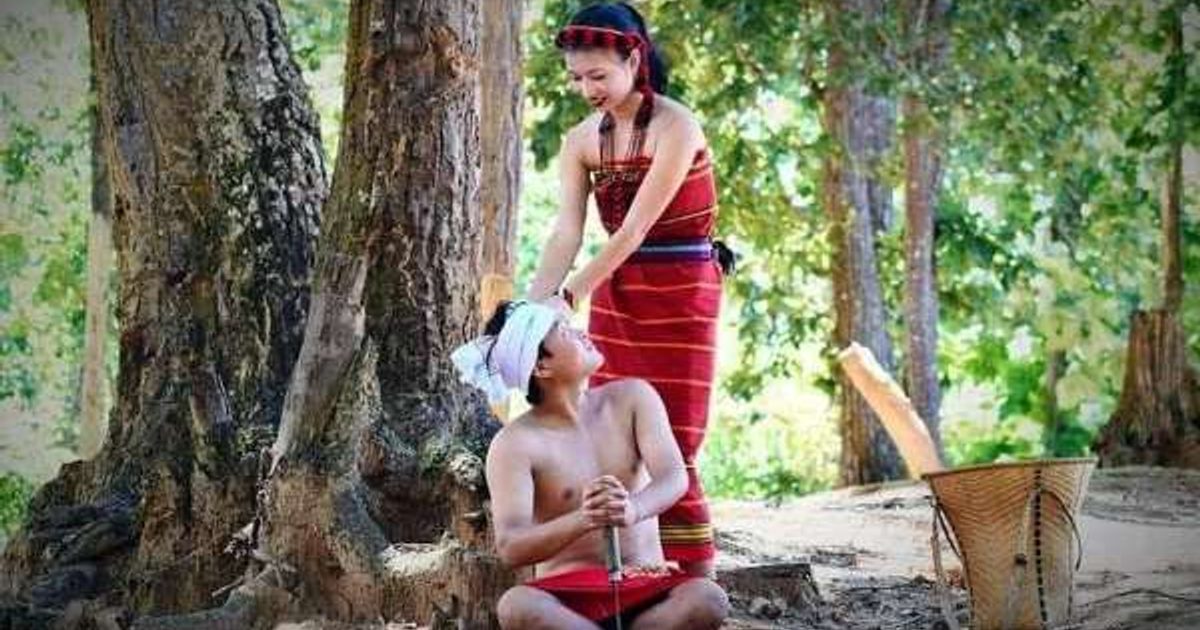
Cultural
Cultural life of a community gives beauty and i 1 life to the members for generations. Every community has its own life style which is and enable everyone to cherish what has been handed down to them enable the members of every community to be firmly attached to the manifested in its music, festivals, and the like. These social functions
a) Festivals and dances: are cheerful people, they love songs . The Choreis, by nature, are songs and festivities. Every festival is celebrated I with great rejoicings amidst Songs and dances..Community meal is an important item in every social celebration. Even when they work in the field or walk towards the jhum, there is song and laughter. Every important occasion or stage in one's life is celebrated. The dances and the songs connected therewith can be grouped
under three main categories depending upon the time and occasion that inspires them to celebrate. They are: a) Family Festival, b) Harvest Festival and c) Social Festival.
1) > Family festival:
The occasions within the family that offer opportunities for celebrations are known as 'family festivals'. There are many such occasions within a family which are celebrated with friends, relatives and neighbours.
) Zutuithan (rahming aphuo) :
After the birth of a baby when it is ready for detaching the naval cord, a ceremony is held within the family in which the baby is given a name. While giving a name to the baby, the Choreis are particular that the ancestral lineage is kept up. Hence one syllable from the, grandfathers will be added to the name of the baby. If it is not possible to get it, ,then they would tum towards the grandmother. The name is normally chosen by the family and proposed to the priest who officially gives the name. If the priest is not present, one of the elders in the family will give the
name.
ii) Naituolinsuok:
Before giving a name to the new born baby, there is another ceremony called 'naituolinsuok' in which the baby is brought out of the house for the first time and is shown before the sun. This ceremony is done on the 3rd or 5th day of the birth of the baby.
iii) Artuitan:
It is a simple family celebration compared to 'laibun' and parsenpei'. When one is not able to have either 'laibun' or 'parsenpei' because of some reasons or other, that person would take recourse to 'artuitan'. In this celebration, no priest is required; elderly women can perform it. A place near a river or stream is chosen and an altar made
of bamboos is erected. An egg is placed in front of the altar and it is cut into two at one stroke with a sharp knife. The deity known as 'tuituol ar' is invoked.
iv) Parsenpei:
This ceremony has a special significance for the members of the Chorei community. Hence it is solemnised by inviting all the villagers and relatives. During this ceremony, a red flower is given in the hands of the child. It is to show that the baby has successfully completed its first stage of life, and has entered into the second stage by becoming a
child. During this celebration, the child is given rice for the first time. Then a plate filled with flowers, leaves, fruits, etc., are placed in front of the child to see which object the child picks up. Accordingly the
elders would make up their mind concerning the future of the child.
v) > Laibun:
This celebration is had as the last ritual of the infant stage. Kith and kin are invited, and a sumptuous meal, as per the traditional custom of the Choreis, is served. Now-a-days, this celebration is not given importance at all.
vi) Luongbom inbom and dierkeinkei:
When a child enters into adolescent period, the Choreis celebrate it in a meaningful way to announce the growth of one of their members from childhood to to adolescence. When a boy reaches the adolescent period, the celebrations had in his name is known as 'dierkeinkei'; but in the case of a girl, it is known as 'luongbom inbom'
2) Harvest Festival:
Harvest festivals of the Choreis can rightly be termed as village or community festivals since all the celebrations connected with the cultivation, harvesting, etc., involve all the members of the village. The whole village would sing, dance and enjoy together as members of one family.
i) Loivatlam:
We have already seen in the earlier chapters that land was and is considered as the main source of income for the Chorei people. Before the rainy season, they cut down all the bushes and grass stripping the whole area of cultivation bare. After completing this phase of their work, they are free untill the plants are dried up. During this period,
the youth would come together and rejoice by singing and dancing. This merry making is known as 'loivatlam'.
ii) Manginkhomlam:
Having cleared the place of cultivation in the 'jhum', they would wait for about a month so that whatever was slashed would dry up in the scorching heat of the sun. The dried ones are gathered and burning. When this second phase of work is over, they have a celebration known as 'manginkhomlam'.
iii) Butulam:
After burning the dried up plants, the land is prepared with the help of sharp instruments such as spade, dao, etc., and seeds are planted. After completing the planting of seeds, they rejoice by dancing butulam'
iv) Loichuonlam:
Every plant requires constant care if it has to have a healthy growth and produce abundant fruits. This principle is very much applicable to cultivation everywhere. Keeping this wise principle in mind, the Choreis do not keep on enjoying songs and dances all the while. Instead, they go to the fields and try to give every care and attention the young
plants require. If weeds show their heads, they are to be removed immediately so that the plants may grow well. The first phase of weeding is done in the month of April. After completing this work, they rejoice by dancing 'loichuonlam'.
v) Sarkuogkhang:
It is a common place knowledge that with one weeding we cannot rest assured that the weeds will not appear again. Constant care of the plants is needed, and periodical weeding has to be done. Hence, the second phase of weeding in the month of May. During this period, a sacrifice known as 'sarkuogkhang' is offered. It is a 'khodoi' (community festival) with 'khodoilam'48 and 'sapite lam'. These dances are initiated by the 'ochei' (priest) with the decorated bamboos, and is followed by elders and youth of the village.
3) Social Festival:
In all the festivities, there is a social dimension. The members of the society or the village are involved in all the celebration, if not in a greater degree, at least in a small way. In this respect, all the celebrations can be termed as social celebrations; but there are certain festivals which do not necessarily involve the society even though relatives and friends may attend them. The common celebrations which invariably involve the community at large on occassions which are purely social can broadly be termed as social festivals. i) Rallam and Ralratlam: In the early part of their life, the Choreis moved from one place considerable power over the whole community and looked after the
to another under the leadership of certain chief who exercised when the situation so warrented, the chief assumed the role of a king well being of the people with the help of his subordinates, Later on, and had an army raised to defend his people from external threats. After the success in the battle-field, when they returned, there was such a great joy that they celebrated the victory through 'rallam' and 'ralratlam'.
ii) Sathatlam:
This dance is associated with hunting wild animals. When a wild animal, especially that which is a nuisance and disturbance for the people and for their cultivation, is hunted down, it is considered to be a sigh of
bravery on the part of the hunter. Hence the whole village celebrates this great successful hunting by performing 'sathatlam'.
iii) Koteklam:
It is a bamboo dance which is communitarian in nature. There is no specific occassion assigned for the performance of this dance. But any joyful occassion would have this dance, especially if there is a social gathering. This kind of bamboo dance is found among many of the Mangolian communities in India and in other countries. The Mizos, for example, have a bamboo dance which is performed during important events. In the same way, it is said that even in Malaysia, the people of the Mangolian stock have dances with bamboos.
iv) Soksolarut:
Snails are considered to be the delicacies in the food items of the Choreis. They collect these snails from the river-side and prepare them well. As the preparation of snails is well appreciated and cherished by the Choreis, they dance out the process of collecting them, bringing them home, cleaning them and cooking them.
v) Cheminkan :
The ancient Chorei society depended very much on the instruments of self defence which were used by others at that time. When the kings of various ethnic communities used swords, the Choreis too improved their skills by training their men in the art of using swords skilfully. This training in the use of swords found its in roads in the field of entertainment. The crossing of swords, known as 'cheminkan', was introduced as a bravery dance.
vi) Arkhonginkhel:
It is a kind of game in which the players would tie a turban on the head first, and after folding the left leg backward, would hold it tight with both the hands at the back. Then they would move from place to place within a specified area on one leg trying to push down others. This game which is known as 'arkhonginkhel' (cock fight) brings a lot of amusement and entertainment to everyone.
b) Ornaments:
Ornaments of various type have an important place in the life of the people of Chorei community. In the past, both men and women used to wear ornaments. Women used to wear them in order to adorn themselves and appear more beautiful; whereas men used to wear them as a sign of bravery or love. Some ornaments were indispensable decorative items during the community celebrations. Though there were different ornaments for various purposes, we present here below some of the important ones.
i) Rathei:
It is a kind of necklace made of silver which was worn by the female folk of the community. It was used primarily as a decorative item of beautification. Hence it is given importance during dances, festivals.
ii) Kuordoi:
It is an ornament worn on the ear. It extends from the top of the ear-lob the bottom. This ornament is something similar to that of the ear ornament of the Nepalis.
iii) Kuordoi Toya :
It is a round ornament worn by women on the lower part of the ear-lob like present day ear ring.
iv) Bala:
It is a thick round ornament worn by women around their wrists like bracelets. This ornament is also considered to be important during community festivals.
v) Kekol:
It is a thick and round ornament similar to Bala. The difference between these two ornaments is that while 'bala' is worn by women, 'kekol' is worn by men.
vi) Samep:
It is a kind of hair-clip made out of either bamboo or wood for keeping their hair on the head in a particular position. 'Samep' becomes neccesary for those who have long hair.
vii) Jakser:
This ornament made of silver resembles 'bala' and is worn by women around the wrist.
viii) Chompar:
It is a decorative ornament which is used as an ear ring only on certain important occassions.
ix) Kuorbet:
It is an ornament like ear ring which is meant for common use. Though it resembles 'chompar' which is meant for special occassions only, 'kuorbet' is for constant use.
x) Kutsobi:
It is an ornament for the finger. Both men and women wear this ring on the index finger. Presenting 'kutsobi' to someone is a sign of love.
xi) Maduli:
It is an ornament which resembles an ear ring but attached to a long chain. One end of this chain is attached to the hair at the bach of the head with the help of 'samrep' and the other end which has the ear ring like object is drawn straight to the middle of the forehead.
xii) Banriel:
It is something like a flat round bracelet which coils thrice round the wrist. It is used on the left hand by the male members of the defence cardre to show their courage and valour.
xiii) Tangka rathei:
It is an ornament made of round coins to be worn around the neck. It is an important decorative item during cultural performances. In olden days, the Choreis prefered ornaments made of silver. But now, with the knowledge of the cost and value of bronze and gold, they prefer ornaments made of these costly materials.
c) Dress:
Various ethnic communities all over the world as well as northeast India, are normally distinguished from the rest by their dress. When people of different ethnic communities wear their distinctive dress, it is easier for anyone to identify them. The Choreis also have their own dress which is quite different from that of others. Very often, there is
change in the choice of colour or design or the way they dress theselves. Some of the important ones are given here below:
i) Mulri:
It is a thick and heavy cloth made of cotton to protect oneselfform the cold winter. It is normally white and is used as blanket.
ii) Zonte Mulri:
also a winter garment which is used at night. It is a light white cloth with stripes of cotton lines. This cloth is
iii) Rikop:
It is a shawl like cloth which is normally used over the 'mulri' as bed cover. iv) Jalmunpuonpha: It is a kind of light cloth that is used as bed sheet.
v) Puonhak:
It is a shawl used by male members of the community.
vi) Puonvel:
This garment is similar to 'puonhak' but the difference is that while 'pounvel' is used by female members, 'puonhak' is used by male members of the community.
vii) Derkei:
Airunturuo
This cloth is similar to that of the traditional dress of the Bengalees It worn by men only.
viii) Keipereng:
Quios
It is a piece of cloth measuring 6 inches by 30 inches which is used by men to cover their private parts.
ix) Riemkancholi:
It is a thick shirt used while doing any work in the field. This thick cloth is said to be protecting them from mosquitos and other insects.
x) Puonsen:
juepodun
It is a red cloth which is presented to the bride by her mother for taking the blessing from the elders before leaving the parental home.
xi) Ngoilenghak:
It is a white cloth with orange coloured border. The parents of the bridegroom would give this cloth to the groom who, after wearingit, will get the blessing known as 'ruai' from the elders.
Musical Instruments:
The Choreis love music and they enjoy singing whenever they have a little free time to sit in a company of two or more persons of the same age group. One could sing even when doing some work alone. This shows that there is a natural and inborn tendency to express their feelings of joy and happiness in humming and singing. This inborn tendency in them must have moved them to invent musical instruments.
Some of their most common musical instruments are as follows: i) khuong:
It is a kind of drum made of wood and animal skin. Mostly dear skin is prefered; but there are times when they used goat-skin too. This instrument is used during festivals and on the death of one of the beat, one can easily make out the occassion it signifies.
ii) Rosema
It is a kind of flute made of 'tuium' (water flask). 'Tuium' is a fruit found in the forest. when the inside of it is cleared, it looks like a container in which people could carry drinking water when they go to
jhum or for a journey. It's base is broad and has a narrow neck. The Choreis would insert some bamboo sticks from the mouth of the 'tuium' untill they pierce through the bottom of the container and project out. These holes would make a melodious sound when blown from its mouth. It is used during the festivals.
iii) Dangdul:
It is an instrument made of three flat iron string which converge a point and extend further about six inches appearing as a handle. It is a stringed instrument which is held in the mouth and played with the index finger on the right hand.
iv) Saranda :
It is a musical instrument which resembles very much the violin of the present day. It is made of wood and has just one string. It is played with another string attatched to both the ends of a stick.
v) Theili:
It is a flute made of bamboo, Normally, a special kind of bamboo known as 'ronal' or 'romai' would be prefered for this purpose. It will have eight holes for the fingers, and one opening for the mouth. It is used during dances, festivals, etc.
vi) Daar:
It is an instrument made of bronze, it looks like a plate with an elevation in the middle. It is struck with a piece of wood for musical effect. Normally two or three 'daars' are used for symphony. This instrument is used during pujas or when someone is dead.
vii) Zamluong:
It is a huge 'daar' weighting about 10 to 20 kgs. When there is any danger from outside or when someone is dead, this instrument is used. During pujas, 'zamluong' is neatly cleaned and kept in a prominant place, but not played.