CHAPTER-2: The PEOPLE
According to a study conducted by the members of Molsom ethnic community, it is believed that this people, like the Choreis, came under the 13 sub-tribes of Halam; but it is note-worthy that though each of these communities have something in common, they have their own identiry which is quite distinct from others.
According to some sources, the Halams have 18 sub-tribes' (six more than generally believed or five more than the list given in the Rajmala of Tripura). They are as follows:-
(1) Bong (2).Bongcher (3). Korbong (4). Lankai (5). Chorei (6). Marsephang (7). Dap (8).Migli (9). Ranglong (10).Mitahar (11). Hrangkhol (12).Molsom (13). Kaipeng (14). Rupini (15) Kaljang (16). Sakachep (17). Kaloi (18). Thangachep.
In the early part of the 18th century AD, the then Maharaja of Tripura identified about 13 ethnic groups having more or less similar cultural and linguistic connections and called them 'Halams'. We shall speak of them later when we deal with the co-tribes and clans of theChorei community.
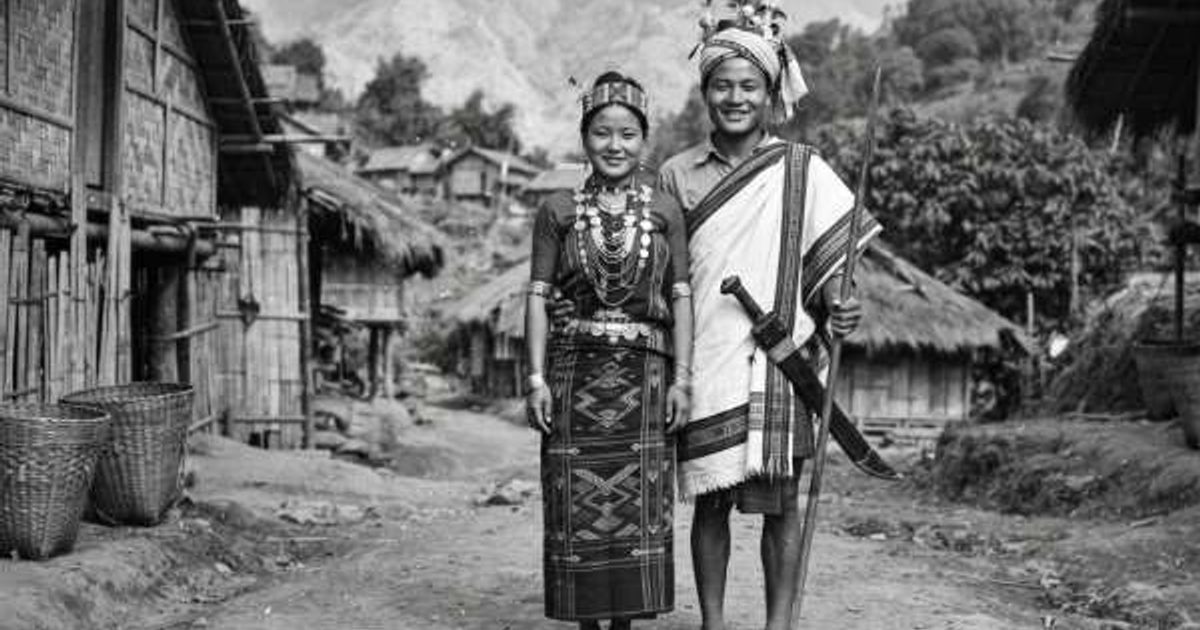
The physical features of the Choreis are rather distinct from others. They are generally short and sturdy with well developed muscles. Their legs are short in comparison with their bodies, and arms long. Their face is nearly as broad as it is long, and is generally round and square. The women are strong and beautiful. Both men and women used to keep long hair.
d) Banian Tree:
There is a story about one of the leaders known as Luopui. According this story, Luopui planted a banian tree called 'abuong kung' in Tamu-Khampat area in Myanmar (Burma) around the year 400 BC, because he noticed that his people were scattered without proper guidance or a strong leadership. While planting the tree he vowed that it would grow so big that the branches would touch the ground; and that when the branches would become greater than the tree itself, all the scattered Chorei people will be united once again.
This 'abuong kung' is still standing in Khampat area as a withness, covering some acres of land. Mr. Vanlalngul Chorei of Manikbond visited the site of the great banian tree in Tamu and Khampat area in the year 1958. According to him, it is covering an area of about 40 bighas. This report of Mr. Vanlalngul is believed to be true by the Chorei people and other co-tribes as it corroborates what had been handed down in their traditional song which says:
"Suolam lian buong bakzar kaiya kachin ulien sakol raja ngei anin bumna chu ei chun muloi ramuola eizuon sirsam vangkhuo ah surti anin chun ngoilung anin bum"
According to legends, a meeting under the shade of great banien tree on the eastern corner of the earth was held. The two brothers of Luopui named Sima Lersi and Mara Buong Khup in the Chindwin valley of the Shan state were present. It is worth mentioning here that during Keipet Kalim in the Bhuban Hill area, the folklore on Archa Rangkachak was very famous. It speaks of the death of a devil in the Kaireng; and it is believed that the hidden treasure is still in the Bhuban Hill.
e) Co-tribes & Clans:
Like the Chorei tribe, there are about 20 other ethnic communities more or less similar culture, custom, language, etc., with a following little variation here and there. As mentioned earlier, in the first part of 1800AD, the Maharaja of Tripura identified 13 such communities and called them as 'Halam" because all these tribes had to inveriably pass through foot-path to reach their villages. In the Kokborok language of the Debburma community, 'ha' means 'earth' and 'lam' means 'path". This explains why the Maharaja chose the word 'Halam' to identify all the 13 tribes collectively. These 13 tribes are as follows:
Hrangkhol, Kaipeng. Molsom, Rupni, Khulong, Dhap, Koloi, Chorei, Morsephang, Long Buongsher, Korbong, Muthilanglo
The twenty tribal communities which have some kind of semblance
with the Chorei community are as follows:
i. Aimol
ii. Biate
iii. Chothe
iv. Chiru
v. Chorei
vi. Hrangkhol
vii. Ranglong
viii. Sakachep
xi. Kochung
xii. Buongcher
xiii. Marsephang
xiv. Tripura
xv. Kom
xvi. Komriem
xvii. Bong
xviii Korobong
xix. Darlong
ix. Kaipeng
x. Morsom (Molsom)
xx. Koireng
These twenty tribes are brothers having a very close relation in their dialect, culture, custom, social system, religious belief, etc. Though they do not have any recognised collective name as yet, they call each other 'Tangmi Nam' which means 'brotheren of the hills'. Here the word 'Tangmi" carries the same implication as the word 'riem'. In the early days, these tribes prefered to identify themselves as 'riem' or hriem'. However, they still wear a dress called 'riem kancholi' and use a basket called 'riem chempai'; and their religion is also known as 'riem doi'. So it is probable that the word 'riem' or 'hriem' might have been used in the past as a reference point of their identity. Like any other major ethnic community in northeast India, the Choreis too have many clans. The important ones are as follows:
. Achep, Aithingrok. Marsephang, Muolpheivai, Arrabu (Khiangte), Neibom Akeite, Ardairiem,
Nobin, Banmaher, Bong, Buongcher, Cholka, Kazari, Khiengtevai, Kombol Khiengte, Khoknu Kuatiavai, Langkei, Lungloivai, Martala, Norsing, Rangkhol, Riem Khiengte, Sakhuoipu Sakhuorbui, Tansurai, Thirsu, Tuisenvai, Tokorai, Vangaru, Vai, Thingphun