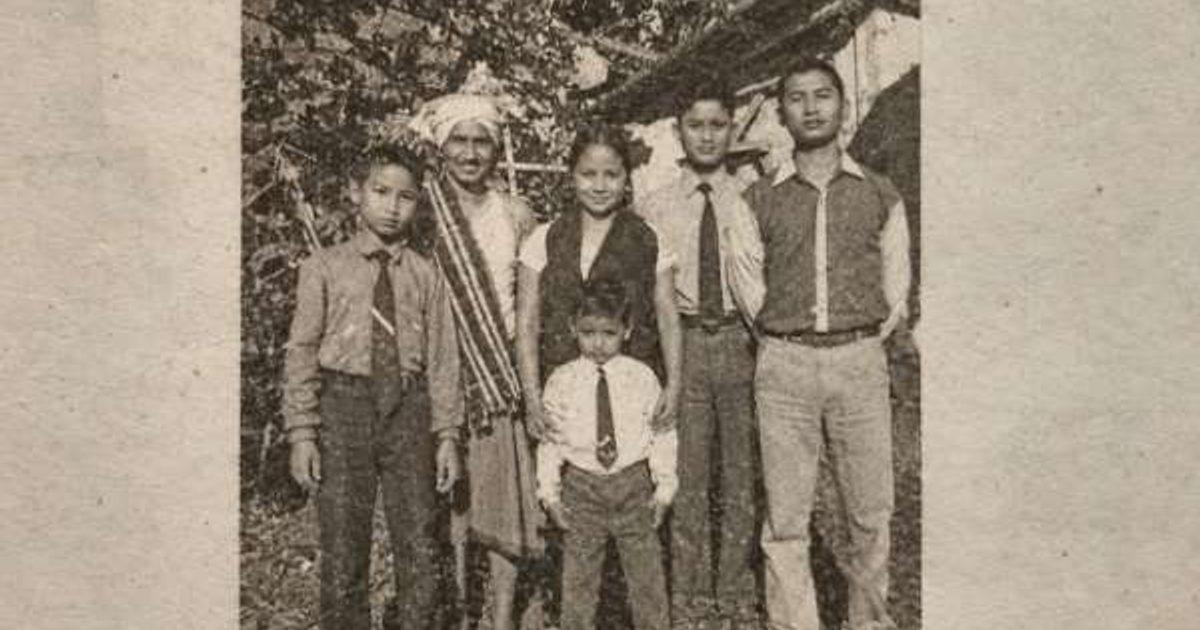
Ngirbulbum was born on 15 May 1956 at Mugura, a village on the bank of the Tuisen river, about 70 kilometres south of Karimganj. He was the youngest son of Mr. Vanlienlal Aithingrok (Chorei) and Mrs. Neitinnei Muolpheivai (Chorei).
Like many people of his community, he grew up with two names. At home he is Ngirbulbum, the name given by his people and their custom. In offices and official papers he is Fonidhor. This is more than a formality. It describes a man who has spent his life between two worlds: the village and the wider society, tradition and institutions.
The Road to Learning
His schooling began close to home, at Longai Lower Primary School, and continued at Katamoni M.V. School in Karimganj district. For high school he went to Sielmat Christian High School in Churachanpur, Manipur, and passed his matriculation in 1976. Those years away from home sharpened his sense of community. He later returned to Karimganj and graduated from Ramakrishna Nagar College in 1982.
A Student Who Chose to Serve
Even as a student he was drawn to organizing and leading. In 1974, while still in Churachanpur, he joined the Manipur Students' Union and the Hmar Students' Association, and served as Secretary of the Chorei Students' Union. He was still a teenager, and he was already working for his people's voice.
He kept building after he came back to Assam:
1978: He helped form the Ta-ngmi Students' Association and became its president in 1980.
He served as President of the District Committee of the All Assam Tribal Students' Union, Karimganj.
1991: He was appointed Chairman of the government-constituted Scheduled Tribe Development Board in Karimganj District.
1995: He became General Secretary of the All Assam Mongoloid People's Cultural Organisation, and Chairman of the Integrated Tribal Development Project in Karimganj District.
He was the first President of the District Committee of the All Assam Tribal Sangha.
The pattern is clear. He did not wait for institutions to be built for his community. He helped build them, and then he worked inside them.
From Service to the Written Word
Alongside this public work, he wrote. His articles have appeared in several leading news magazines, and he has published a few books on the Chorei community. The Choreis is the fullest expression of that effort. A people's history, customs and identity survive when someone takes the trouble to record them, and he took that trouble.
Why He Matters
A resume lists positions, but what stands out in Fonidhor Chorei's life is a steady commitment. He started as a young student in a school hostel town and went on to shape development boards, tribal organizations and cultural bodies, and finally to write a book. For the Chorei people he is both a leader and a keeper of memory. That is why The Choreis is a gift to the generations who will want to know where they come from.
Preface
Ever since my school days, I have had a deep desire: that every tribal community, like communities elsewhere, should cherish its language, customs and way of life, and carry them forward as social and political conditions change. Only then can a community keep its identity, without being absorbed into the lifestyle of the larger communities around it, to the detriment of its own existence.
This desire led me to study the many aspects of the Chorei community, which is not well known to the people of northeast India or to the outside world. My effort has not been without success. With the materials and information I gathered from different sources, I was able to bring out a few booklets and write a few articles on the Chorei community in some of the leading magazines.
After many years of study and reflection, I had collected a wealth of information that, if presented in a booklet, would be of help to everyone concerned. So I have taken care to present the facts about the Chorei community in a systematic way.
This booklet is divided into eight chapters, each giving a detailed account of one aspect of Chorei life:
Origin. The first chapter deals with the origin of the Choreis and gives some idea of the term "Chorei" and of the people.
Social life. The second brings to light family life, village administration and more.
Economic life. The third covers cultivation, marketing, the medium of exchange and related matters.
Religion. The fourth draws our attention to the concept of God, sacrifice, life after death, spirits, priests and so on.
Health and hygiene. The fifth is about health and hygiene as the Choreis practise them.
Cultural life. The sixth deals with festivals, dances, ornaments, dress, musical instruments and more.
Language and folklore. The seventh is on the language and folklore of the Choreis.
Settlements. The eighth is on the settlements of the Choreis in some villages of northeast India.
I am very grateful to all those who helped me with useful information, directly or indirectly, in preparing this booklet. I offer my special thanks to Lt. Laltinphir, Ngirbuljoy, Vanlalngul, Vanneiman, Phunneingir, Lalphunman, Sanglien, Neimanril, Ruolmanlien, Phunvanngul, Lalmanngir, Sukumar, Monotosh, Dorte, Thomas, Mantinhoi and others whose valuable contributions mean a great deal. I regret that I cannot mention here the names of everyone who helped and inspired me in this work.
I am well aware that I could not present a detailed and exhaustive study of the Chorei community, for various reasons. Still, I am confident that this booklet will serve as a launching pad for the younger generation to begin further studies. In my own simple way, I have tried to throw some light on certain aspects of the life and belief of the Choreis. My hope is that it will inspire others to make further enquiries and bring out the aspects of Chorei life that are not dealt with here.
- Fonidhor Chorei 1