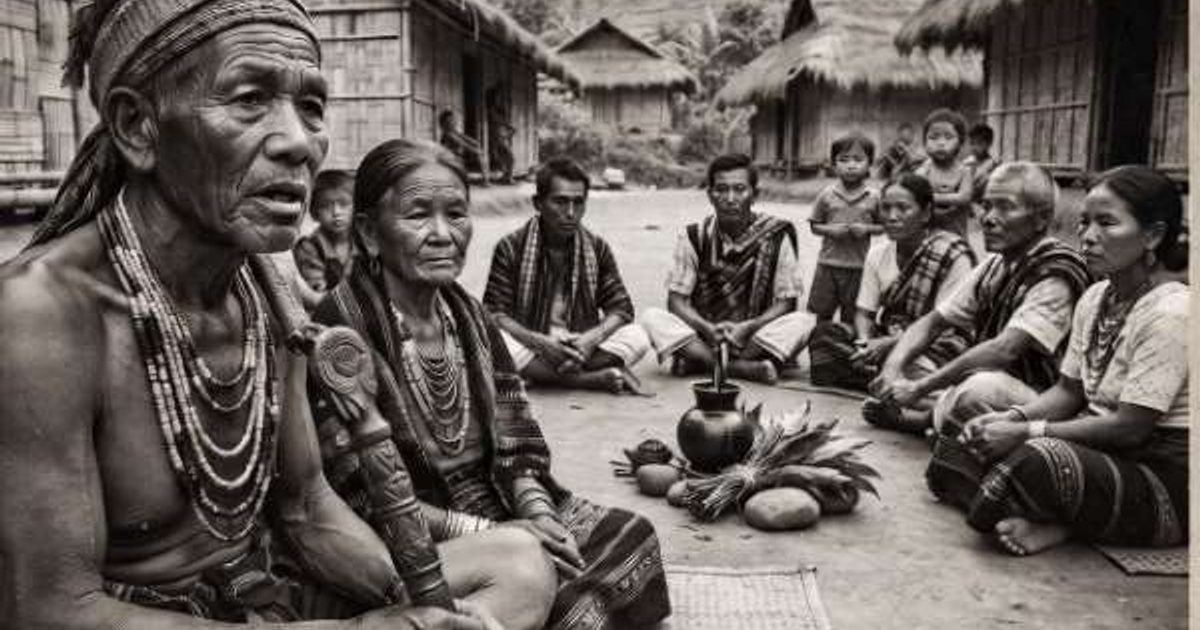
TRADITION SOCIAL SETUP
The unity among the people of Chorei community under their chief was highly praised by others. There was a strict code of conduct which every member - whether male or female, young or old-had to observe. Anyone who deviated from the highly cherished code of the community was severely dealt with. The head of the family was endowed with the responsibility of
taking care of the observance of the code of conduct within the family; the village administration was responsible for the strict enforcement of the same in the village; and in the society, it was the responsibility of the hierarchical structure that was in charge of the observance of this code in letter and spirit. It is important to note here that in the Chorei community, no one was considered as being above the law. Even the law giver or the law enforcing authorities were under the law when it is promulgated and accepted as such. No one had any right to tamper with the law. What had been handed down from the ancestors must be kept intact. No one would ever attempt to bring about any addition or mission of any part thereof. The unity among the members of the Chorei community was such that anyone who wanted to take action against a member of this community would not do so unless he first had assembled all the members of the community and, having explained his position, obtained the approval of the community to proceed with the prosecution of the defaulter.
> "a) Administration."
Kalim or Sengja or Kalim-Kabur system¹² of adminstration of the Chorei community, did not have hereditory succession. The
administration was operated by a group of officials called 'Sengja' (which simply means 'council'). In all practical purposes, the 'sengja' represents the society known as 'vantang'. The head of the 'vantang' is knwon as 'Kalim'. The 'Vantang Kalim' is equal to a king, because he exercises authority over the whole community; whereas the 'Paija Kalim'
is just a 'village head'. Both in the community as well as in the village, the 'Kalim' is assisted by a council or the 'sengja' are which consists of the following members:
> "i. Kalim = Chief
ii. Kabur = Assistant Chief
iii. Chapia Kalim = Deputy Chief
iv. Chapia Kabur = Assistant Deputy Chief
v. Kamsakoy = Women representative
vi. Jakosum = Observer and advisor
vii. Tarpui = Elderly representative
viii. Bangpui = Specially invited elders
ix. Chapia = possible candidate in waiting."
The Kalim occupies his post till death. When the post of Kalim lies vacant because of his death, Kabur is promoted; 13 and this process of promotion would follow serially upto Chapia. This process is known as 'meiserinlek' Here, the persons on probation to be chosen as Chapia need to work under 'vantang' to show their efficiency and faithfulness during this 'meiserinlek'. A feast knwon as 'tarmarie' is celebrated which is directly connected with the selection of Kalim and Kabur. Each and every clan of the community is represented in the 'sengja' paving the way for being offered the potentiality of occupying the highest post. As a part of village administration, there are two kinds of youth associations. The first group is called 'ruothar 14 external forces. In the case of any external threat, the defence group of 'ruothar' will be guided by Tangulien to plan and execute a definitive action. The second group
consists of young boys called 'beibak ruol" who are responsible for maintaining peace and harmony within the village under their leader known as ' siersep' and their assistant leader known as 'sierphit'. b) Selection of Tangulien :
The selection of 'tangulien" (leader of the defence group) is made during a feast called 'hanot' in which there is a ritual of reciting the traditional song known as 'tangulien la' or 'chingtang manmasi la'. This oral recitation is done very carefully because if any part of the past history is left out or wrongly recited, the narrator has to start
again the entire song standing on one leg as punishment for his mistake. This recitation has some improtant events in the life of the Choreis. A close look at some of these lines will help us to understand the
community better.
> "Tuisuosari tuivarleng Lamsuosari lien buongkung".
It shows that in the meeting place of seven rivers and seven crossed roads, there stands a big banian tree. It also brings to mind some of the important leaders like Devanthang, Devanngul, Thairongchong and Reivannu of chorei commnity. Other famous persons who are remembered through the recitation are: Sumtielril - social worker, Changsuosiek and Changsuolien-leaders of the community, Sevanlal- chief priest, Kachanknei alias Doikungpu- a great magician. There is
also a reference to the Kingdom of three brothers named Buongkhup, Lersi and Luopui who ruled the north, south and central portion of the kingdom respectively. Folklores like 'ralngam' and 'muomrang rol' concerning the dedicated life of Marimthng are also refered to.
c) Messanger:
The post of 'tangva" (messanger) is one of the most important posts in the Chorei society. He announces the message to the 'vantang' (society) by moving on foot from one corner of the village to the other end of the 'vantang'. The term of office for the post of 'tangva' is one year. Every villager will have to act like 'tangva' when he is called for. As part of social work, the 'tangva' is responsible for collecting firewood from each house in case of the death of any villager.
d) Family:
Family is the basic unit of a society; and so in order to understand any community, one needs to have a close look at the family. Unlike the Khasis of Austro-Asiatic stock and the Garos and Lalungs of Tibeto-Burman's stock who follow the matrilineal system, the Choreis follow the patrilineal system of life both in the family and in the society.
Though more responsibilities are held by men, we can say that there is a certain amount of equality of both the sexes in the Chorei community. The Chorei family is patriarchal by authority, patrilineal by succession and patrionymic by descent. Thus property is inherited along the male line. Male equigeniture is the general rule with regard to inheritance. The ancestral property is given to the youngest son since he has the responsibility of looking after the parents in their old age. If the ancestral property is shared among the sons, the youngest son will get the share of the parental house. However, the parents can, if they want to, provide a share of their property to the daughters.
The contribution of the women in the economic sphere of the family is considerably great. Besides the household chores, they engage themselves in cultivation, collecting fodder and firewood, and rearing poultry birds and cattle20. They also take active part in singing folklores on certain important occassions. After the father's death the brothers take up the responsibility of getting their younger sisters married. The inter family links are most visible during social functions such as marriage, death, etc.
e) Marriage:ccom
Among the Choreis, marriage is mostly endogamous, that is, it is always within the given social group; in others, marriage is exogamous, i.e., it is within the tribe but outside the clan. Marriage among them is mostly matrilocal, namely, the boy goes to live in the house of the parents of the girl during 'maksa' which is explained in the following
paragraphs. The method of obtaining a mate by using the custom of courting was generally practised; but it was done in secret, when the girl's family was asleep. Monogamy was the common form of marriage; but there
were exceptional cases where ploygamy was practised. Though there is no discrimination between male and famale, in
respect of marriage, the girl is given more importance. The boy would select the girl of his choice as his life long companion by means of 'kholaichei' in which both of them go for a walk as and when time permits. This offers an occassion for both of them to express their views and to understand each other. Another method employed is 'lu inkhui' in which the boy helps the girl in combing the hair. Here again, while arranging the hair of the girl, the boy is able to speak out his mind and understand that of the girl. If and when the boy and girl agree for marriage, the boy's guardians would visit the house of the girl with a proposal to that effect. This system of arranging the marriage is called 'chong rakel zu' because a pot of beer known as 'beer of enquiry' is brought by the boy's family when they approach the girl's family with their proposal for marriage. If both the parties are in agreement for the proposed marriage, then 'biak zu' which is equivalant to the presant day engagement is conducted by offering home made rice beer. After these functions, the boy or the bridegroom would serve the girl's family for a period ranging from one year to seven years as per agreement". Normally, the period of service, known as 'maksa' is fixed according to the demand of the girl's father, i.e. the 'Tarpu' (father-in-law). As the boy leaves the family and goes to Tarpu' to begin his 'maksa', a ritual known as 'lut zu is performed. After the successful completion of the period of 'maksa', the final
marriage known as 'ruoi zu is celebrated. S₁ Marriage celebration is one of the important social functions of
the Chorei community. Therefore, all the relatives of the bride and bridegroom as well as all the villagers are invited. Participation of some of the leaders of the society is a must in 'ruoi zu'. On the night of the marriage, the bridegroom's party would go to receive the 'moisa' (bride), and before bidding farewell, both the bride and the bridegroom are blessed along with their attendants by the elders who were seated according to the order of their social standing. Then the brothers of the bride would give the final goodbye to their beloved sister which is
called 'mokotkhar'. After the farewell ceremony in the parental house of the bride,
the couple will be accorded a solemn reception in the maternal uncle's
house of the 'moisa'. This function is commonly known as 'mamapu
On the next day, the closing ceremony, known as 'ruaipek' would
be observed in the house of the boy as a reception ceremony for the
newly wed couple. Here again, the elders would bless the couple in a
function called 'tuiabuak'. In this function, both the couple and their
attendants (one boy and one girl) would sit (khuk-sabil) on bended
knees covering the head with a handmade cloth called 'ngoilenngak
The elders would bless them by pouring water (tui), rice (sisai), cotton
(patphuo), and a special flower known as 'vaisen'. In this process of
'ruai pek' (blessing) or 'tuiabuok' (pouring water) there is a recitation
which goes as follows:"Ka chong nimak ka la nimak naruol nachim
neikhel I rang sarai pherzam ei sip rang tui suon koilam eiman zik rang
ringtuoh nei suorang, damtuon nei suo rang chunglu vai ang ei par
markhuk thunglur ei ler rang".
(These are not my words, not my song; you will be a champion
among your friends. A vast land will belong to you. Even the zig-zag
stream will be straight. Have a long life, good health, for many years.)