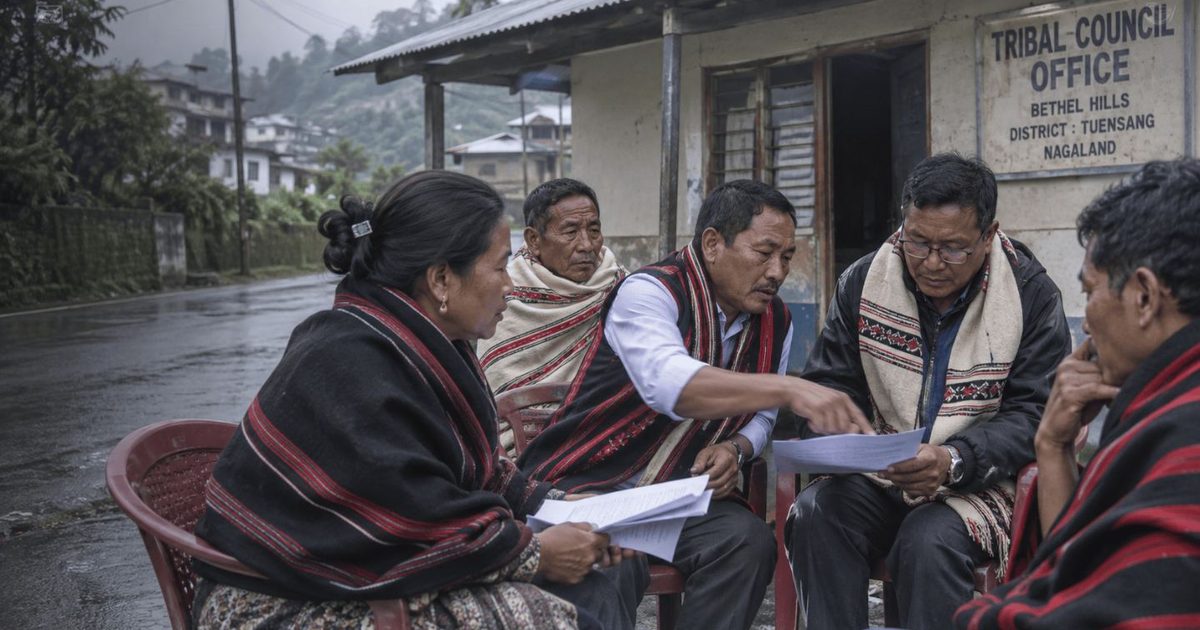
The Sixth Schedule in the Indian Constitution enables tribal autonomy. This issue is gaining prominence in Meghalaya, Assam and Ladakh in 2026.
What is the Sixth Schedule is detailed in articles 244(2) and 275(1). It gives autonomous district councils to tribes within Assam, Meghalaya, Tripura and Mizoram. There are 10 autonomous councils in total. (vajiramandravi)
Unlike the Fifth Schedule (which gives tribes in other parts of the country limited autonomy, and puts them largely under the control of the Governor), the Sixth Schedule gives elected councils legislative, judicial and financial powers.
Powers of Autonomous Councils
Legislative: Passing legislation on land use, unreserved forests, shifting cultivation, local administration, inheritance, marriage and social customs, with the assent of the Governor.
Judicial: A local court system for tribal members in villages and at district level, within the permitted areas.
Financial: Collecting revenue via taxation, market duties, tolls and a portion of royalties. Provide education, health and road provision.
Unlike councils established by state legislation, councils established under the Sixth Schedule have legislative and judicial powers. Councils established under state legislation have very limited administrative, executive and financial autonomy. (thewire)
Unpassed Amendment:
An amendment to article 280 and the Sixth Schedule was approved by the Union Cabinet in 2019. This aimed to increase powers of the councils. It included:
Establishing State Finance Commissions in Assam, Meghalaya, Mizoram and Tripura. (scroll)
Women to be reserved for at least 1/3 of village and municipal councils in Assam, Mizoram and Tripura. (drishtiias)
At least 2 women to be nominated in each autonomous council. (drishtiias)
However, this bill (125 th Constitution Amendment Bill) was still in the Upper House in December 2025, and has been in limbo for over 5 years. As a result, the councils have been “in limbo” and do not receive their fair share of development funding. As of yet, this bill has not passed. (indiatodayne)
Issue in Meghalaya (Garo Hills)
A large issue has occurred in the Garo Hills. On 9 th March, a local notification was passed by the Garo Hills Autonomous District Council (GHADC) to prevent non-tribal candidates from standing in the election. Due to this disturbance, the election (originally due on 10 th April) was postponed. 2 people were killed when security forces opened fire on a violent mob in West Garo Hills. (NortheastMeghalaya cabinet extends GHADC term amid clashes +2)
Since then:
Legal issues regarding who can stand. The Meghalaya High Court quashed the original notification requiring ST Certificates on 10 th March. However, an amended rule was passed in the council, with assent from the Governor, meaning that candidates must have a Scheduled Tribe Certificate. (scroll) (scroll)
Extensions to council term. The extension was initially 6 months (18 th April to 18 th October). On 7 th October, the cabinet approved a further extension to the term. This extension was due to delimitation and the SIR process. Under the rules, the maximum extension period is 1 year, split into 2 6 month periods. (Meghalaya Cabinet Extends GHADC Term by Six Months Amid Tribal Row +2)
No intervention from courts. However, the high court declined to order the government to conduct elections. It supported the extension notice. (uniindia)
Issue in Assam:
Multiple councils in Assam (Rabha, Tiwa, Mising, Deori, Sonowal Kachari and Thengal Kachari communities) want to be under the Sixth Schedule. However, in July 2023, the state noted that no time frame can be given, as the proposal is under consideration by the Centre. (indiatodayne)
Politically, in 2026, the BJP led NDA won 20/21 assembly seats in Sixth Schedule areas in Assam. This may be due to heavy reliance on the state government for coordination and funding. (indiatodayne) (indiatodayne)
Issue in Ladakh:
Ladakh has gained a lot of prominence in this issue. In November 2025, following violence and killings in September, proposals were submitted by Ladakh representatives to place it under the Sixth Schedule and gain statehood. However, a regulation came into effect on 19 th October, changing the current Hill Development Councils and effectively dissolving the Kargil council. Ladakh is now set up with councils in all 8 districts. The first panchayat elections in Ladakh since 2018 will be held on 21 ST November. (why self rule still matters in indias tribal homelands +2)
However, there are criticisms. Hill councils do not have the same powers as Sixth Schedule councils (such as Bodoland Territorial Council) to create legislation on land and culture. The Kargil Democratic Alliance have raised concerns in relation to recent changes in discussion. (civilsdaily)
Watch:
Whether the 125 th Constitutional Amendment Bill gets passed.
When Garo Hills council elections will take place, and whether the ST certificate condition will be applied.
Whether plains tribal councils in Assam will be granted Sixth Schedule status, by the Centre.
Outcome of discussions in Ladakh on statehood and Sixth Schedule status.
Why it Matters
Although this issue is complex legally, it is very important in deciding land ownership, who can stand in elections and protecting tribal culture. Regardless of what happens in these discussions, the outcome will affect governance in the NE for many years.