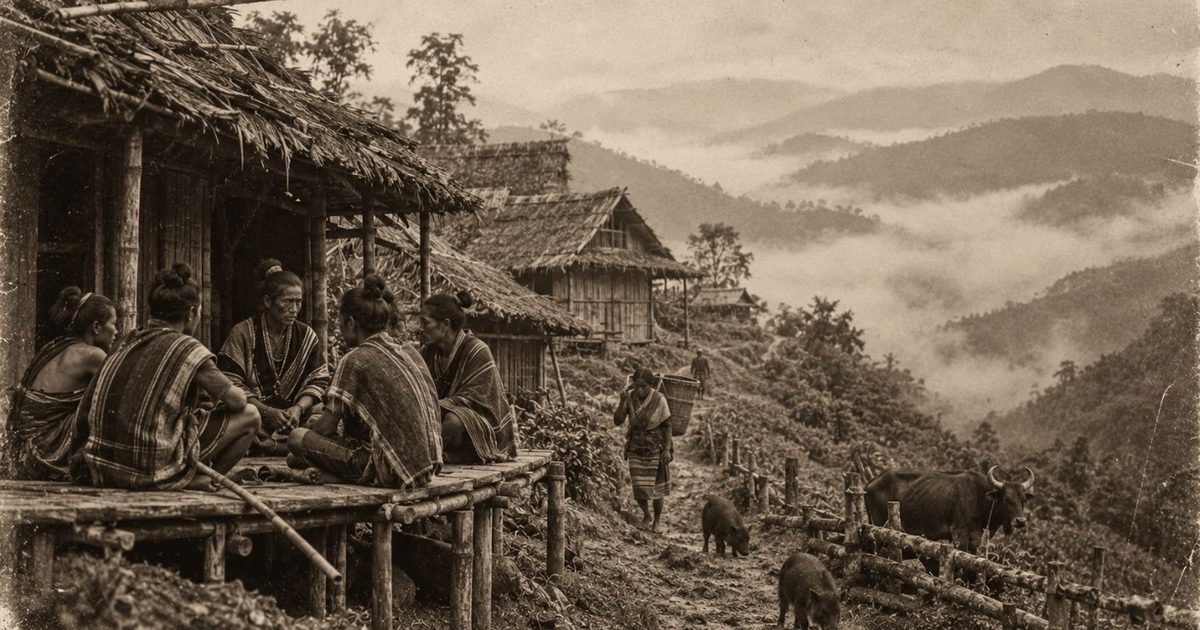
William Shaw, a colonial officer in Tamenglong, Manipur recorded his observations of the Thadou in the 1920s. In his notes, edited into a book by Hutton, the constant movement of the people is mentioned many times. Families love to break away into small hamlets of just two or three houses. This means that villages are rarely found where you expect them to be. Shaw mentions how when he asked why they do this they replied “We are birds”. However, Hutton, who had known them for years felt that this was more historical than natural, as whenever they arrived in a new place the land was already occupied and they would never get the chance to settle.
[Thadous](https://choreinow.com/tribes/thadou) history is full of migrating. They remember moving from near the Imphal river down the Chindwin river. Eventually they reached the hills of current Chin and Lushai country. Here they lived with the Lushei, Suhte and Poi people. Often there was a lot of conflict between them. Villages were burnt down, they made peace with the shield and spear and gave shelter to a small clan known as the Galte. The Gangte later betrayed the Thadou chief by plotting against him. Eventually they were forced to move North.
There were also conflicts within the people themselves. The Shingshon clan once refused to follow the Shitlhou chief. They fought a huge battle on Songchal hill. The Shingshon lost and eventually became loyal to the Shitlhou chief in Jampi. Another story is about a chief named Tungkhopao who took his people to the Raja of Ava in Burma to ask for help from the Raja of Manipur. He asked for help for three years but became nervous and returned to make peace in Manipur.
The Manipuris call them Khongsai. The Thadou explain this by saying it is named after the first village they met from the Manipur kingdom. This village was owned by the Lhungum clan and was destroyed by two famous warriors.
Inside the villages the chief usually had a wooden veranda where the men would gather to discuss village issues. Before founding a new village they would look for signs in their dreams and how the egg acted when placed over a small fire. Shaw was not impressed by the messy lanes, pigs and carefree water supply. However, Hutton had a fondness for them. The more he got to know them the more he liked them. He admired their bravery, honesty and light-hearted humour. However he could not say the same for their farming skills or temperance.
The elders had a big responsibility to remember the long family trees and what debts and dowries were owed by each branch. Hutton mentions how they were the "text books" for the younger generations and this is perhaps why they often looked so serious.
They are a proud, argumentative and humorous people who remembered their history as they spent a lot of their time on the move.
Discover more about [ThadouTribe](https://choreinow.com/tribes/thadou)
[Note: William Shaw (ed. J.H.Hutton) Notes on the Thadou Kukis (1929) (Spectrum Publications reprint 1997)]