1. Origins, Ancestry & Clan Lineage
In the hills of the north-east of India, i.e. Tripura, lives a people whose name records their past. This is the tribe known as Molsom Dofa belonging to a group of sub-tribes commonly called Halam. They used to be regarded as "No.1 Halam" in ancient times and till now the people of Tripura regard them as loyal and truthful subjects under their kings.
A name born from ten hillocks
According to folk memory the Molsoms used to live long ago in a place called Bolpuitang in the north-eastern hills of India. The village was located in the midst of ten hillocks, from which derives the name "Malsom", mal being hillock and som, ten.
The various forms of the word, viz. Murchum or Mursum (corrupted forms used in Government papers and census) and Molsom (a light form) have passed down the word to the present day.
Part of the Baro Khil Halam
The Malsoms are a part of the larger tribe called Halam. This is believed to have originally been divided into twelve sub-tribes. Hence the term Baro Khil Halam, the twelve tribes of Halam. The tribal names are:
Malsom, Kaipeng, Hrangkhawl, Kalai, Rupini, Bongcher, Karbong, Langkai, Chorai, Morsophang, Ranglong and Thangachep.
Other sub-tribes later joined the main group of Halam, they being Natianglong, Nasbang, Saimar, Dab and Sangachep, which are said to have branched from Bongcher, Karbong, Langkai, Morsophang, Ranglong and Thangachep.
The Molsoms, thus, are seen to have a Halam culture similar to the other sub-tribes with a few variations in the traditional diet, rites and rituals, and in the pronunciations of their language.
Thirteen clans, named after the natural world
The organisation of the Halam tribes is based on clans, known as Panchi (or Tero-Panchi). There are thirteen clans of the Malsoms:
1. Chhungphun (also written Sungphun)
2. Uisa
3. Lengman
4. Mapu
5. Nokham (Nawkham)
6. Nawmpor (Nawmpawr)
7. Lourak (Lorak)
8. Singar
9. Achep
10. Lungthung
11. Dourai
12. Tuisum
13. Rawnte
Each clan has been named after various domestic objects and those found in nature like Nawmpor (leaf), Nokham (fire), Achep (forceps), Lungthung (oven), Singar (wild cat) and Chhungphun (trap).
2. Geographic Presence & Regional Settlements
A people spread across Tripura
Today, the Molsoms are settled all over Tripura with the exception of Unakoti and Belonia districts.
Beyond the state border
There are smaller communities in the Cachar district of Assam, Mamit district of Mizoram and in Chittagong in Bangladesh.
Village life
The Molsom villages are on the same pattern as other Halam villages. Family groups of approximately fifty or more households are put together in forested interior areas. The villages are headed by a Choudhuri (head man), who is the highest authority at this level.
Superior to the village head is the Molsom Rai (called the Halamsa) who is the chief of the entire community, to whom any matter that could not be resolved by the Choudhuri would be brought.
3. Living Culture, Customs & Heritage
Life with the hills and the forest
Traditionally the Molsoms are dependent on the products of the hills. The economy consists of gathering wild vegetables, fishing, hunting, basketry, weaving and Lau (shifting cultivation), better known as jhum. In jhum the crops sown include paddy, cotton, melon, sesamum, chilli, ginger, turmeric, maize, cucumber, pumpkin & more.
The site for a jhum garden is chosen in November and December and the selection is made with reference to omens. A choice of site is made by dropping two halves of bamboo to see what omen they indicate and sleeping with a lump of soil under the arm in order to read the dream. Clear water, high mountain and fishing are considered good, and a watch hut, Kaireng is later constructed in the field.
No harvest can be eaten until it has been offered to the Sun and Moon (Nini-Thapa), the offering of new rice being a festival called Buthar nek.
Jhum cultivation is now in decline as many Molsoms have shifted to plough cultivation on the plains, growing pineapple, guava, jackfruit, mango, lemon, orange, banana, coconut, litchi, betel nut and other fruits and timber trees.
Hands that weave and craft
The weaving is done by the women and the men deal with basketry. The products of the women are the Pawnzel (lower garment), Rwsa (upper garment), Ponhak (wrapper), Kanchili (shirt) and Lukom (turban), while the men basket the Chawk (fishing trap), Rwlwi (winnowing pan), Darhak (large drying mat), Japa (a small box-like case) and Bem (a carrying basket).
Basketry is an art highly valued and it is expected of a young man to become proficient in it before marriage, at the very least being able to make a cradle, the Wareng, for his child.
Dress and ornaments
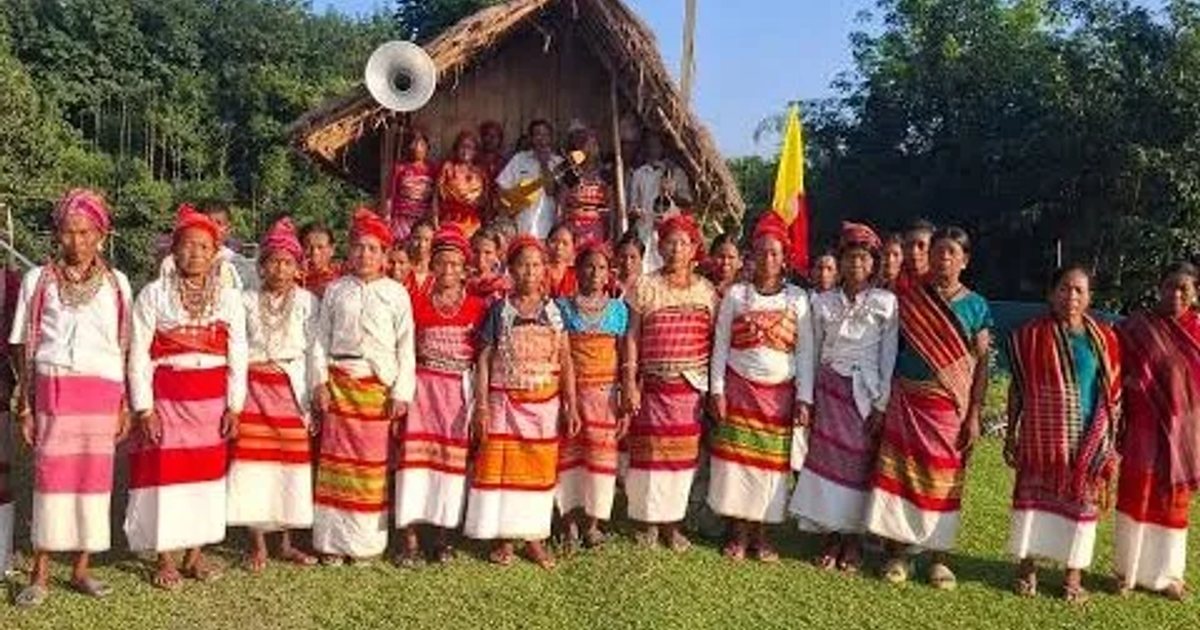
The traditional male wear was a loin cloth called Puidari. The modern wear for a male is a cotton dhoti and Kanchili. The female wear consists of Rwsa (tied under the arms) and Pawnzel (tied at the waist and falling at just below knee level).
Many ornaments are loved by the people; these are worn by both men and women and these include the necklaces (Rwthwi), coin necklaces (Sumrui) that can cover the chest, ear rings (Nabet), nose flowers (Nakuphul), hair ornaments (Samkil), wrist rings (Bala) and finger rings (Kutsabi). Girls have their ear lobes pierced at a young age and the hole is widened gradually to accommodate the Nabet.
Food, drink and etiquette
The forest is their pantry. Women and girls collect bamboo shoots, wild brinjal, banana flower and shoots, cane tops, mushrooms, tubers and various leaves; the men collect honey and fruits from the top of trees. Fishing is done with hands, traps, nets, spears and the juice of a creeper, Ru, to stupefy the fish.
Liquor is an integral part of nearly all the social and religious occasions, starting with birth and marriage and ending with death and worship. The local liquor Rakzu is prepared in a clay and bamboo still called Batibau, which is prepared by women, who bathe and wear clean clothes before hand. The order of serving liquor is: the village priest (Ochai), then the Choudhuri, followed by his assistant (Khandol) and finally by the elders. The guests of honour may be offered liquor prepared from Sazu rice.
Play, music and dance
Games are a popular pastime and among boys the most popular are Poi-rwdai (a seed shooting game), Retet (wrestling), Singronon (bamboo pole wrestling), and Tuikumzong, in which a boy ties one anklet to a post and pretends to be a flying insect. Among girls the popular games are Ribi-rwba (hide and seek), Bu-ante-er (cooking and eating), and Thwmte-ta (weaving tiny cloths).
There is rarely a Malsom that does not possess a musical talent, at least in singing. Songs and dances are part of most of the ceremonies and the Hwihak dance, Chongpreng lam and Sarel lam are among the best known.
Faith and festivals
Traditionally the Malsoms are not atheists. They worship many gods like the Sun and Moon, Likhi (the goddess of prosperity), Inkil Pathwn and the spirits of trees. Their traditional God is Sengrak, an ancestor and great warrior believed to have protected them by defeating evil forces. His temporary temple is at Manithangbari (Manithang para) in the Udaipur Sub-Division of South Tripura district.
The prime festival is Khawser (Kerpuja) celebrated every year in the village under the Choudhuris and centrally at the home of the Halamsa. Contributions are made from every household, the worship being in winter to ensure that the season of jhum work (clearing, burning and sowing) is free from accidents. The village elders meet at the Rai's house to discuss their problems, and the evenings are spent in traditional song and dance.
The kings of Tripura appreciated the Malsom customs, courts and shared Sanatan Hindu faith, and some Malsoms are followers of Vaishnavism. However, in recent years there has been a great change among them, with a large number shifting to Christianity, approximately 60% of them following this religion.
Family, marriage and community law
Each family is headed by its In-pu (usually the oldest male member) in the absence of an adult male being his wife. The headman represents the family in village matters, including selection of Choudhuri.