** How the Choreis Governed Themselves**
Long before modern institutions reached the hills, the Chorei tribe had built a system of self-government that outsiders admired. Its strength was unity, and that unity rested on a shared code of conduct everyone understood and respected.
** One Code for Everyone**
Every member of the community, man or woman, young or old, was expected to follow the code. Those who strayed from it were dealt with firmly. Responsibility was layered. The head of each family made sure the code was observed at home. The village administration enforced it across the village. At the community level, the leadership structure watched over it "in letter and spirit."
The most remarkable principle was that no one stood above the law. Even those who made or enforced it were bound by it once the community accepted it. Nobody could alter what the ancestors had handed down, and nobody could add to it or take anything away. Unity ran so deep that a person with a complaint against a fellow member could not simply act. He first had to gather the whole community, explain his case, and win its approval before proceeding against the accused.
** The Sengja: A Council, Not a Crown**
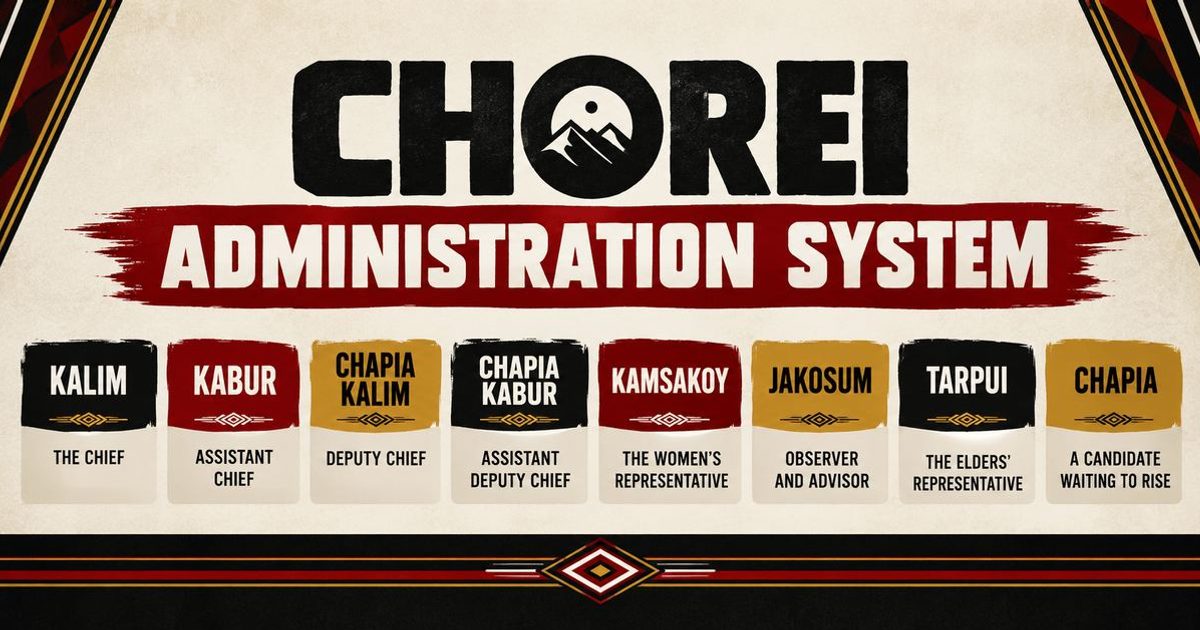
The traditional system is known as the Kalim or Kalim-Kabur system, and it did not pass leadership from father to son. Authority rested with a council of officials called the Sengja, which in practice represented the society known as the Vantang. The head of the Vantang was the Kalim, who held authority much like a king over the whole community. A village head, the Paija Kalim, held the same title at village level.
The council had nine roles:
Kalim – the chief,
Kabur – assistant chief,
Chapia Kalim – deputy chief,
Chapia Kabur – assistant deputy chief,
Kamsakoy – the women's representative,
Jakosum – observer and advisor,
Tarpui – the elders' representative,
Bangpui – specially invited elders,
Chapia – a candidate waiting to rise,
A Kalim served until death. When the post fell vacant, the Kabur moved up, and each rank after him advanced one step in turn. This process was called meiserinlek. Those waiting at the bottom had to prove their efficiency and loyalty by serving under the Vantang. A feast called tarmarie was celebrated in connection with choosing the Kalim and Kabur. Every clan had a place in the Sengja, so every clan had a real chance of reaching the highest position.
** Guarding the Village**
Villages also had two youth associations. The ruothar was the defence group, ready to respond to any outside threat under its leader, the Tangulien. The beibak ruol, made up of young boys, kept peace and harmony inside the village under a leader called Siersep, helped by an assistant, the Sierphit.
** A Song Sung on One Leg**
The Tangulien was chosen during a feast called hanot, which included reciting the traditional song Tangulien La, also known as Chingtang Manmasi La. The recitation carried the community's history, and the rules for it were strict. If the singer left out or wrongly recited any part of the past, he had to begin the whole song again while standing on one leg. The penalty was a way of keeping memory accurate, since the song held important moments in the life of the Choreis.
** Why It Still Matters**
The Chorei system balanced authority with accountability. Leaders rose through service, women and elders had seats at the table, every clan had a stake, and the law was bound to tradition and to everyone equally. For the Chorei community today, it is a reminder that unity came from fairness, shared responsibility and respect for what the ancestors passed down.